Highgarden
Fire & BloodHighgarden is the seat of House Tyrell and a principal center of power in the Reach. Its surrender during Aegon’s Conquest transformed the fortunes of its steward’s family: Aegon granted Harlan Tyrell the castle, its domains, and authority over the former vassals of House Gardener. In later generations, Highgarden’s lords and lands repeatedly mattered to decisions about royal allegiance, regional war, and the settlement of power across the realm.
Definition and Dynastic Transfer
Before the conquest, Highgarden belonged to the Gardeners, whose house ruled the Reach. When Aegon marched west to complete the conquest, he found the castle held not by a Gardener but by its steward, Harlan Tyrell. His forebears had served the Gardeners for centuries, and he surrendered the keys without a fight, pledging his support to Aegon. The change was therefore both a transfer of a great seat and a political promotion of a family formerly in service to its rulers.
Aegon rewarded Harlan with Highgarden and all its domains, naming him Warden of the South and Lord Paramount of the Mander. He also gave him dominion over the former vassals of House Gardener. The grant made the Tyrells regional overlords under the new royal order, while preserving the Reach as a great territorial power within the unified realm. Highgarden’s significance thus rests not only on its association with an old ruling house, but also on the deliberate reallocation of that house’s authority after conquest.
Conquest and the Cost of War
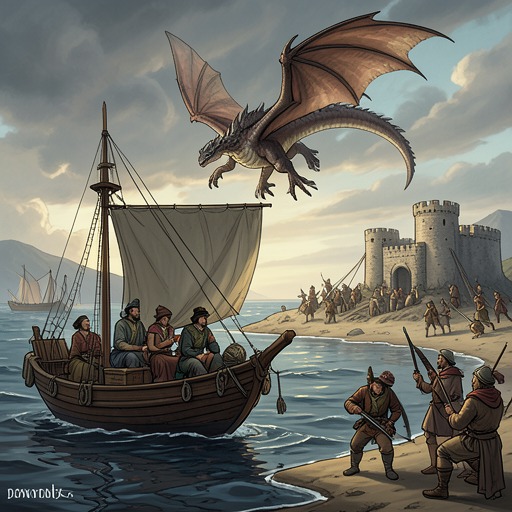
The contrast between Highgarden’s unresisting surrender and the violence of the wider conquest is sharp. Before Aegon reached the castle, the two western kings had assembled a formidable host near Goldengrove: Mern IX Gardener of the Reach and Loren I Lannister of the Rock commanded fifty-five thousand men, including more than five thousand mounted knights. The campaign destroyed the Gardeners’ rule; afterward, Aegon’s grant made their former steward the lord of their seat and the power that had once answered to them.
The Tyrells’ new regional position also brought military responsibilities. During a later invasion of Dorne, Orys Baratheon led knights through the Boneway while Aegon advanced through the Prince’s Pass with a large army. Harlan Tyrell, then Warden of the South, was associated with the confidence that the invading forces could overwhelm any Dornish army that opposed them. The campaign instead exposed the limits of numbers and rank: as Harlan’s host marched toward Hellholt, the heat and poisoned water sources killed horses and men. By the time he reached the castle, Hellholt had been abandoned; Harlan had lost a quarter of his men and almost all his horses. Highgarden was the seat from which the Warden’s authority derived, but that authority could not make the southern campaign secure.
The consequences reached back to Highgarden after Harlan’s death. Aegon flew there on Balerion to take counsel with the new Warden, the young Theo Tyrell. Theo was reluctant to contemplate another invasion of Dorne after the fate that had befallen his father. In this exchange, the castle is more than a symbol of a grant: it is the place where the crown sought counsel from the regional lord whose family had borne the cost of an earlier war.
Allegiance and Political Competition
Highgarden’s influence was visible again during the struggle between Maegor and Jaehaerys. After the Velaryons declared for Jaehaerys and Maegor lost the royal fleet, the Tyrells of Highgarden followed with the power of the Reach. Their declaration belonged to a wider sequence in which major houses turned against the king. The castle’s lordship connected a regional army and its political allegiance to the contest for the Iron Throne.
That connection became more complicated during the Dance of the Dragons. When the conflict began, the young Lord Tyrell’s mother acted as his regent. Although the Lannisters had declared for Aegon, the Reach was not simply an extension of the same commitment: the prince’s supporters considered the possibility that the regent might align with the Hightowers, who were powerful bannermen within the region. House Tyrell’s position mattered precisely because its allegiance could not be assumed from the choices of other great houses.
As discontent spread among the Reach’s bannermen, the Tyrell regents reconsidered their support for Aegon and decided that House Tyrell would take no part in the struggle. Later, when the king sought further armies, Casterly Rock, Highgarden, and Oldtown replied slowly and offered excuses rather than promises. The Tyrell regent wrote that she doubted her son’s bannermen would remain loyal and was not fit to lead a host herself. Highgarden’s political weight therefore coexisted with a practical constraint: the regional lord’s name could not guarantee that the region’s divided forces would follow.
Lords, Claims, and Royal Progress
Highgarden’s lands and title also attracted ambition from within the warring royal factions. After Hugh Hammer and Ulf White had joined the queen’s cause, Ulf received the lordship of Bitterbridge but wanted Highgarden, arguing that the Tyrells had taken no part in the Dance and should consequently be attainted as traitors. At Tumbleton, both he and Hugh refused to support an advance on the capital unless their demands were met: Ulf sought Highgarden and its lands and incomes, while Hugh wanted a crown. The demand turned the castle from an inheritance held by a young lord into a prize in a larger struggle over reward, regional authority, and kingship.
The castle also appears within the realm’s circuits of travel and governance. Queen Elinor Costayne, after leaving King’s Landing following Jaehaerys’s accession, travelled to the Vale and then to Highgarden, where one of her sons had been fostered with Lord Tyrell. Her visit placed the Tyrell household within the networks of fosterage and royal kinship that connected distant regions. In 89 AC, Jaehaerys’s progress brought him to Highgarden, and from there he travelled with Princess Rhaenys to the Shield Islands, landing on all four. The castle served as a stopping place in a royal journey that carried the king into lands he had not previously visited.
A proposed progress in Aegon III’s reign gave Highgarden another place in a plan for consolidating royal rule. The suggested route would proceed down the sea road through the Reach, including Highgarden, Goldengrove, and Old Oak, before continuing toward Oldtown. The proposal presented the journey as a public beginning for the king and queen’s reign, extending royal presence from the Dornish Marches to the Wall. Across these episodes, Highgarden recurs as a seat of delegated power, a destination for royal counsel and travel, and a possession whose importance could draw both loyalty and ambition.